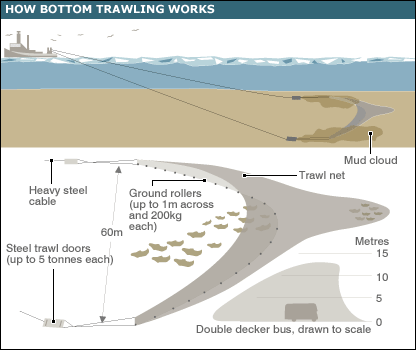
Certain types of fishing gear can damage the physical structure of marine habitats as they pass over the ocean floor. Bottom trawls used to capture demersal fish species and dredges used to capture scallops have been shown to be particularly damaging to sensitive [1].
These methods also capture significant amounts of both vertebrate and invertebrate by-catch, disturb benthic sediments and crush or bury benthic organisms. Community composition may be altered as a result [1].
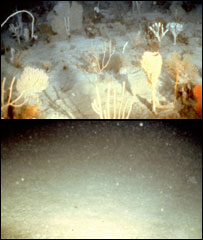
Seafloor before (top) and after (bottom) trawling
Some benthic habitats such as the deep sea coral reefs off the coast of Alaska are particularly vulnerable to bottom trawling. Invertebrates such as these form an important structural component of these marine ecosystems. Other habitats such as muddy or sandy bottoms that do not have marine invertebrates as an important structural component may not be as vulnerable to bottom trawling [2].
Repeated damage from this fishing gear can slow or prevent the recovery of these degraded benthic habitats and probably contributes to the slow recovery rates of some fish stock, even when fishing effort is reduced. The extent of damage to benthic communities by fishing gear is largely unknown and is currently an active area of research [2].
References
- Kaiser, M. J. Collie, J. S. Hall, S. J. Jennings, S. and Poiner, Ian. R. (2002) Modification of Marine Habitats by Trawling Activities: Prospects and solutions. Fish and Fisheries. 3: 114-136.
- Gianni, M. (2004) High Seas Bottom Trawl Fisheries and Their Impacts on the Biodiversity of Vulnerable Deep-Sea Ecosystems. [Online].