The decline of one species can have impacts that reverberate throughout the ecosystem in a domino-like fashion, represented in a trophic cascade [1].
For example, seals feed on many of the same species as cod, and these species all show increases over the same time period. In addition, it has recently been demonstrated that seals are significant predators of cod, accounting for 21% of cod mortality since 1993 [2].
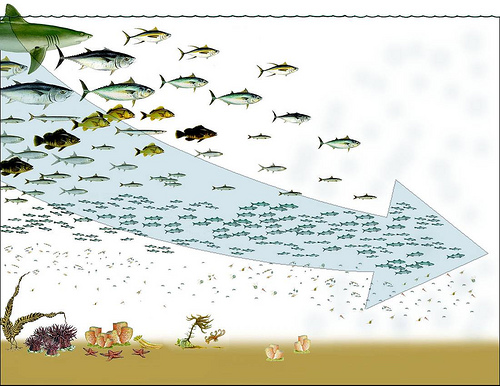
Fishing down the food web
This may be contributing to the slow recovery of cod despite decreased fishing pressure. Studies such as these enhance our understanding of the interconnections between marine ecosystem components and point out the potential hazard of species-level only management [1].
For these reasons it is valuable to know the expected density of individuals in the next generation of Atlantic cod to determine the detrimental effects that might occur as a result of a declining population. The Beverton-Holt model, introduced in the context of fisheries in 1957, was used to calculate expected population densities [3].
References
- Pauly, D. Christensen, V. Guenette, S. Pitcher, J. Sumaila, U. R. and Walters, C. J. (2002) Towards Sustainability in World Fisheries. Nature. 418: 689-695.
- Mohn. R. and Bowen, W. D. (1996) Grey Seal Predation on the Eastern Scotian Shelf: Modelling the Impact on Atlantic Cod. Canadian Journal of Fisheries Aquaculture Science. 53: 2722-2738.
- Jensen, A. L. (1996) Beverton and Holt Life History Invariants Result from Optimal Trade-off of Reproduction and Survival. Canadian Journal of Fisheries Aquaculture Science. 53: 820-822.