It is suggested that the impact of commercial fishing is so great that it is affecting the evolution of some fish species, and that changes may be occurring in only decades that under normal circumstances would take millennia [1].
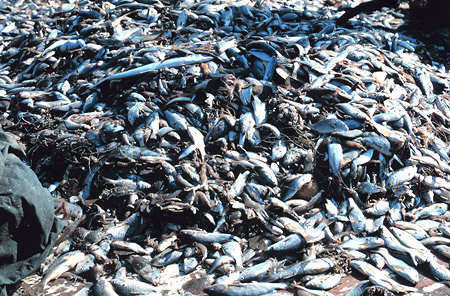
Overfishing leads to rapid evolutionary changes
The fishing pressure on Atlantic cod in the Gulf of St. Lawrence, Canada targeting larger individuals may have resulted in a permanent, genetic change in the population. For economic and fishing technology reasons fishing mortality is heavily skewed towards larger individuals [2].
Decades of such strong selection favour smaller, faster maturing, slower-growing fish which are at an advantage because they delay their vulnerability to the fishery [2].
At present, the possibility of fishing pressure driving genetic changes in exploited fish populations has not been taken into account in fisheries management [3].
References
- Law, R. (2000) Fishing, Selection, and Phenotypic Evolution. ICES Journal of Marine Science. 57: 659-668. [Online].
- Olsen, E. M. Lilly, G. R. Mikko, H. M. Morgan, J. Brattey, J. and Dieckmann, U. (2005) Assessing Changes in Age and Size at Maturation in Collapsing Populations of Atlantic Cod (Gadus morhua). Canada Journal of Fisheries Aquatic Science. 62: 811-823.
- Garcia, S. M. (1998) The Precautionary Principle: Its Implications in Capture Fisheries Management. Ocean and Coastal Management. 22: 99-125.